
Business owners often reach a point where they spend too much time and effort on finances instead of running the business. At that point, many companies start asking the same question: How do you outsource an accountant?
What Does it Mean to Outsource an Accountant?
Outsourcing an accountant essentially means partnering with an external accounting team instead of hiring all accounting personnel in-house.
The outsourced team can handle responsibilities such as:
- Month-end close processes
- Financial reporting
- Account reconciliations
- Budgeting support
- Cash flow reporting
- Forecasting
- Financial analysis
- Accounting process improvement
Depending on the provider, this may include a single accountant, a controller, or an entire accounting team.
Why Companies Choose to Outsource Accounting Functions
Maybe the business owner receives financial statements every month, but still cannot answer important questions like:
- Are margins improving or declining?
- Is working capital increasing or shrinking?
- Is inventory properly valued?
- How much cash will be available in the next 90 days?
- Are projects generating the expected profit?
It’s important to realize that these are accounting and financial management questions, not bookkeeping questions. If you have a bookkeeper that just isn’t cutting it, it may be time to upgrade. Outsourcing gives you access to accounting expertise without taking on the costs and complexity of a full internal department.

How Do You Outsource an Accountant?
Step 1: Identify What You Need Help With
Before contacting providers, you should first determine where your current accounting process is struggling. Here are some examples of problem areas:
- Delayed financial statements
- Inaccurate reporting
- Lack of internal controls
- Weak budgeting processes
- Poor visibility into cash flow
- Limited accounting leadership
- Difficulty hiring qualified accountants
Step 2: Evaluate the Provider’s Operating Model
Not all outsourced accounting providers operate the same way a quick Google search says they do. Some assign accountants who split their time across numerous clients. Others provide dedicated resources who work exclusively with one organization.
Important questions to ask a potential accounting partner:
- Will the team be dedicated to our company?
- How many clients does each accountant support?
- Who reviews the work?
- How often will we meet with the team?
- What happens if a team member leaves?
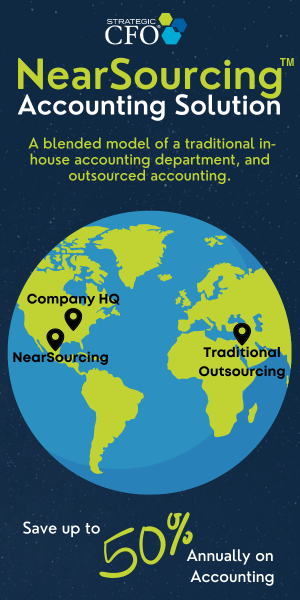
At Strategic CFO, our outsourced accounting model provides dedicated accounting resources supported by experienced accounting leadership. Depending on each client’s needs, the engagement may include a senior accountant, controller oversight, or a broader accounting team. Unlike many outsourced providers, the professionals assigned to your business are dedicated to your company and become familiar with your operations, reporting requirements, and financial goals. Reach out today to learn more!
Step 3: Evaluate Communication, Security, and Technology
Communication, accessibility, and data security impact the success of an outsourced accounting relationship just as much as technical expertise.
When evaluating a provider, clarify communication expectations:
- How often will we meet, and who attends reporting reviews?
- What are the standard response times and escalation procedures?
- Will we have direct access to accounting leadership?
Additionally, ask detailed questions about their technology and security:
- What data security practices and backup procedures do they use?
- How do they manage user permissions and access controls?
- Do they operate in a secure remote environment?
A qualified provider should easily explain exactly how your financial data is protected and how they stay in touch.

What the Best Companies Do Differently
| Common Mistake | Better Approach |
| Selecting the lowest-cost provider | Evaluating reporting quality, oversight, and communication |
| Using shared accounting resources | Working with dedicated accounting professionals |
| Outsourcing only bookkeeping tasks | Using accounting support for forecasting, analysis, and planning |
| Treating accounting as a back-office function | Integrating accounting into business decision-making |
| Waiting until reporting problems become severe | Improving accounting processes before issues affect operations |
So, is outsourcing an accountant right for your business?
If you are feeling overwhelmed by your business finances, you are completely in character for a growing company. Bringing in outside help isn’t a sign of weakness. Outsourcing is actually a strategic move if you are tired of staring at monthly reports that don’t actually help you make decisions, or if you are simply exhausted by the endless cycle of hiring and training internal staff. Hiring an outsourced accountant can give you your time back and, more importantly, give you total confidence in your numbers!
Ready to Build a Stronger Accounting Function?
Many companies come to Strategic CFO looking for help with outsourced accounting. As the business grows, those conversations often expand into financial and operational reporting, accounting department efficiencies, interim CFO support, and other accounting consulting services that help leadership gain better visibility into the business. If you’re facing a major transition, we can also assist with restructuring initiatives and mergers and acquisitions.
If you’re wondering how to outsource an accountant, our CFO consultants would be happy to discuss your current situation.
Schedule a Free Consultation today to get started.