
Engaging outsourced accounting introduces a structured approach to financial management, but the transition requires a defined process. The first 90 days establish that foundation.
Defining the Concept of “Outsourced Accounting”
Outsourced accounting provides the depth and structure that standard bookkeeping providers lack. It encompasses month-end close processes, financial statement preparation, account reconciliations, cash flow reporting, and analysis that translates numbers into operating insight.
At its core, outsourced accounting answers a certain set of questions: Why did it happen? What does it mean? What should we do next?
What Happens in the First 90 Days of Outsourced Accounting?
The first 90 days follow a structured progression, but execution matters. The model should reflect a dedicated team, consistent communication, and alignment with your operating environment. Here’s how we typically go through that process at Strategic CFO.
Phase 1 | Days 1-30: Assess, Stabilize, and Integrate
The first month is the most hands-on. It’s about making sure the foundation is solid before we build on it.
- Historical Data Cleanup: The team reviews the prior year’s ledger to identify misclassifications, unrecorded liabilities, or reconciliation gaps that may skew current year-over-year comparisons.
- On-Site Discovery: A kickoff meeting is held at your headquarters. This allows the team to map your physical operations (inventory, workflows, department structure) to the digital chart of accounts.
- Workflow Integration: Communication is moved into your internal channels (Slack, Teams, or Zoom). The goal is to function as an embedded department rather than an external vendor.
- System Permissions: We take over management of your existing accounting software, ensuring user access is secure and data entry points are standardized.
Phase 2 | Days 31-60: Build Structure and Accountability
Once the data is clean, the focus shifts to creating a repeatable “close” process. This stage is about removing the variability that often plagues midmarket accounting.
- Month-end close calendar: We establish a hard 10 day deadline for closing the books. This makes sure that financial leadership is making decisions based on data that is still relevant.
- Standard operating procedures (SOPs): Every accounting task from vendor payments to revenue recognition is documented. This captures institutional knowledge and ensures continuity regardless of personnel changes.
- GAAP compliance: Financial statements are aligned with U.S. GAAP standards. This creates the “audit ready” posture required for bank reporting or future due diligence.
Phase 3 | Days 61-90: Deliver Insight and Financial Visibility
By the third month, the accounting function moves from recording data to providing analysis.
- Cash flow visibility: We implement 13 week cash flow forecasting. This moves management away from bank balance monitoring and toward a rolling 90 day liquidity view.
- Formal financial reviews: We conduct your first strategic review to analyze variances and explain exactly why results differed from the budget.
- Margin and segment analysis: We begin reporting profitability by product line, customer, or department. This helps identify which areas of the business are generating cash and which are consuming it.
- Forward-looking projections: The team assists in identifying financial capacity for upcoming capital expenditures or hiring plans based on actual performance trends.
What Changes After the First 90 Days
By day 90, the accounting department should no longer be a source of stress. The focus shifts from fixing the past to planning the future.
The main shifts you will notice:
- Reliable financial statements: Financials are consistent, GAAP aligned, and suitable for lenders or external stakeholders
- Cash flow visibility: Structured forecasting replaces reliance on bank balance monitoring
- Timely reporting: Financial reports are delivered on a consistent schedule aligned with management needs
- Margin clarity: Profitability is understood at the product, service, or customer level
- Reduced management burden: Oversight of accounting processes is embedded within the engagement structure
Comparing Your Options
The following summary reflects the most common structures businesses consider when evaluating how to build or improve their accounting function.
| In House Accounting | Basic Bookkeeping | Outsourced Accounting | |
| Cost Structure | fixed salary + benefits + overhead | lower cost, limited scope | variable, scales with complexity |
| Financial Reporting | possible if experienced hire | rarely included | included; structured reporting |
| CFO Level Insight | requires senior hire ($200k+) | not available | built into engagement model |
| Scalability | requires rehiring or restructuring | limited | adjusts to business needs |
| Audit Readiness | depends on staff quality | often lacking documentation | built into processes |
| Onboarding Time | weeks to months | days | structured 30-90 day ramp |
| Decision Making Support | depends on role defined | minimal | core deliverable |
Note: Costs and capabilities will vary based on provider, scope, and business complexity. The table above reflects general market conditions for midmarket businesses in the $10M-$100M revenue range.
Working with Strategic CFO
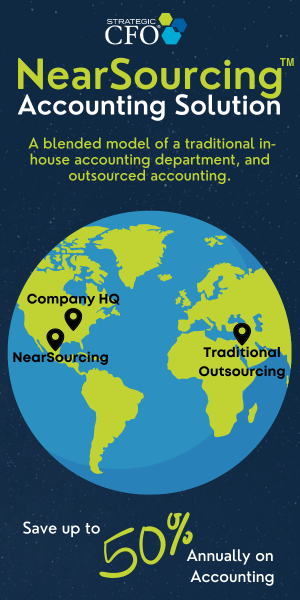
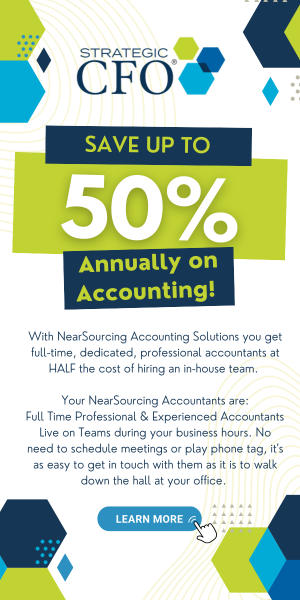
Strategic CFO provides a dedicated team of outsourced accounting consultants for a fraction of the cost of an internal hire. We work in your time zone and travel to your office for regular in person reviews. This is not remote only outsourcing. It is a blended model designed to keep your financial operations connected to your business leadership!
Schedule a free consultation to calculate your exact cost savings and learn what a Strategic CFO engagement would look like for your business.