
In manufacturing, inventory is more than just what sits in the warehouse, it is a financial lever that affects profitability, taxes, and compliance. The accounting method you choose to value inventory directly influences Cost of Goods Sold (COGS), gross margins, and even strategic pricing decisions.
Because inventory often represents 20 to 60% of total assets in manufacturing firms, the stakes are high. Selecting the wrong method can distort financials, mislead management, and cause compliance issues under GAAP or IFRS.
Why Inventory Accounting is Critical in Manufacturing
Manufacturers deal with three main types of inventory:
- Raw Materials
- Work-in-Process (WIP)
- Finished Goods
Each category accumulates costs for materials, labor, and overhead. When those costs move into COGS, the timing and method of recognition determine:
- Gross Margin Accuracy: Profitability can look stronger or weaker depending on inflation and costing method.
- Tax Exposure: Some methods accelerate expense recognition, lowering taxable income.
- Compliance: LIFO, for example, is allowed under U.S. GAAP but prohibited under IFRS.
- Operational Decisions: Whether to run long production cycles, stockpile raw materials, or implement just-in-time manufacturing.
The Four Primary Inventory Accounting Methods
1. FIFO (First-In, First-Out)
- How it works: The earliest raw materials purchased are assigned to production and COGS first.
- Financial impact:
- During inflation, ending inventory is valued at more current, higher costs.
- Results in lower COGS and higher gross margins.
- Higher taxable income compared to LIFO.
- Strategic note: FIFO provides balance sheet values that better approximate replacement cost, which is critical when manufacturers must price products in line with rising material costs.
2. LIFO (Last-In, First-Out)
- How it works: The latest material costs are expensed first when calculating COGS.
- Financial impact:
- During inflation, COGS reflects higher, recent input costs.
- Results in lower taxable income and improved cash flow from tax deferral.
- Ending inventory is undervalued because older costs remain.
- Regulatory note: Permitted under U.S. GAAP with IRS conformity requirement, but not allowed under IFRS.
- Strategic note: Common in industries with volatile raw material prices such as metals or chemicals. Manufacturers gain tax benefits but risk weaker-looking financials for lenders or investors.
3. Weighted Average Cost (WAC)
- How it works: Total costs of goods available for sale divided by total units equals average cost per unit.
- Financial impact:
- Smooths price fluctuations across raw materials and WIP.
- Produces more stable COGS and gross margins.
- Strategic note: Works well for high-volume manufacturers such as chemicals, plastics, or textiles where items are interchangeable and tracking specific costs is impractical.
4. Specific Identification
- How it works: Each item of inventory is tracked individually with its actual cost.
- Financial impact:
- Highest accuracy in cost matching.
- No smoothing or averaging, COGS reflects true cost of specific items.
- Strategic note: Feasible only for manufacturers of high-value, low-volume goods such as aerospace, custom machinery, or defense. Requires robust ERP or tracking systems.
Numerical Example: FIFO vs. LIFO in Action
Imagine a manufacturer buys raw materials at rising prices due to inflation:
- Purchase 100 units at $10 each = $1,000
- Purchase 100 units at $12 each = $1,200
- Total inventory: 200 units at a cost of $2,200
The company sells 120 units. How does COGS differ under FIFO and LIFO?
FIFO Calculation:
- First 100 units from $10 layer = $1,000
- Next 20 units from $12 layer = $240
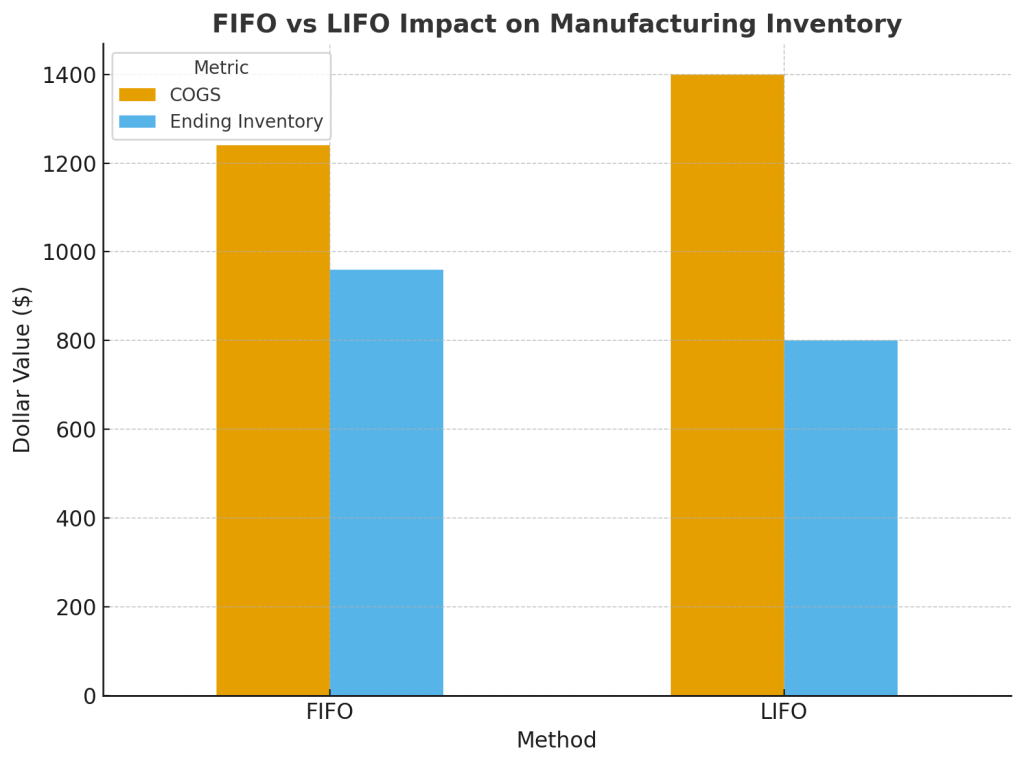
- COGS = $1,240
- Ending inventory = 80 units at $12 = $960
LIFO Calculation:
- First 100 units from $12 layer = $1,200
- Next 20 units from $10 layer = $200
- COGS = $1,400
- Ending inventory = 80 units at $10 = $800
Impact:
- FIFO shows lower COGS, higher ending inventory, and higher reported income.
- LIFO shows higher COGS, lower ending inventory, and lower taxable income.
For manufacturers, this difference directly impacts gross margins, cash flow, and tax liabilities.
Technical and Regulatory Considerations
GAAP vs. IFRS:
- LIFO is acceptable under U.S. GAAP if also reported for tax purposes under the LIFO conformity rule.
- IFRS prohibits LIFO, so FIFO or WAC must be used internationally.
IRS Requirements:
- IRS Form 970 must be filed to elect LIFO.
- Changing methods requires IRS approval and can trigger Section 481(a) adjustments.
Cost Accounting Standards (CAS): For government contractors, CAS 411 governs inventory accounting practices.
Overhead Allocation: Manufacturers must consider how labor and overhead absorption interacts with their chosen method, especially under standard costing systems.
Strategic Guidance for Manufacturing CFOs
Manufacturers should evaluate inflation exposure by monitoring raw material indices such as the Producer Price Index. If prices are rising, LIFO may provide tax advantages but only if you operate under U.S. GAAP.
CFOs must also weigh cash flow versus optics. FIFO may boost reported profits but increase taxes, while LIFO reduces taxes but depresses net income on paper.
Align your chosen method with ERP or MRP systems to ensure reporting consistency, benchmark against industry peers to avoid misleading margins, and plan for global operations since IFRS restricts inventory methods differently than GAAP.
For some organizations, adopting a NearSourcing® model can further enhance alignment between inventory accounting, financial reporting, and strategic decision-making.
Key Takeaway
For manufacturers, inventory accounting is not just a compliance decision, it is a strategic lever. Whether it is using LIFO to shield cash flow during inflation, FIFO to align with global reporting standards, or WAC to stabilize volatile inputs, the right method can enhance decision-making, improve liquidity, and strengthen competitive positioning.
Action Step: Review your current method in light of raw material volatility, tax exposure, and reporting requirements. A periodic reassessment, especially in times of inflation, can create significant financial advantages for manufacturers.
👉 Need a deeper dive into optimizing your inventory accounting for manufacturing? Click here to schedule a complimentary consultation and discuss how our team can help align your accounting practices with operational and financial strategy.